
Executive Summary
Pahadi Masala is a small-scale masala processing and packaging unit based in Rudrapur, Uttarakhand, specializing in organic, high-quality spice blends inspired by Uttarakhand’s culinary heritage. With an initial investment of ₹4,90,000, the unit will produce ground and blended masalas using local spices like turmeric, coriander, cumin, and specialty Pahadi blends. Targeting health-conscious consumers, local retailers, and e-commerce platforms, the business aims to achieve a monthly breakeven sales target of ₹2,00,000 and an annual sales target of ₹36,00,000, with a projected profit margin of 25-30% in the first year. Operating from a 1,200 sq. ft. rented facility with semi-automatic machinery, Pahadi Masala will leverage Uttarakhand’s organic farming ecosystem and government schemes to ensure cost efficiency and scalability.
1. Business Overview
1.1 Industry Background
India’s spice market is projected to reach USD 3.5 billion by 2025, growing at a CAGR of 7.5%, driven by demand for organic and regional spice blends. Uttarakhand, with its organic farming initiatives and proximity to urban markets like Delhi, is well-positioned for small-scale masala processing. Government schemes like PMFME and PMKSY support micro food processing units, enhancing viability. The rise in health-conscious consumers and e-commerce sales further boosts market potential.
1.2 Business Concept
Pahadi Masala will process and package organic spice blends, focusing on Uttarakhand’s traditional recipes and locally sourced spices. The unit will operate in Rudrapur, a hub for agro-processing, using semi-automatic machinery to produce ground masalas and specialty blends. Products will be marketed as authentic, organic, and eco-friendly, targeting local and urban markets, with potential for exports.
1.3 Brand Name and Product Ideas
- Brand Name: Pahadi Masala – Reflects Uttarakhand’s Himalayan heritage, purity, and authentic flavors, appealing to health-conscious and culturally inclined consumers.
- Product Ideas:
- Pahadi Garam Masala: Aromatic blend for traditional North Indian dishes.
- Organic Turmeric Powder: High-curcumin turmeric for health benefits.
- Coriander-Cumin Mix: Staple spice blend for households.
- Himalayan Chili Powder: Spicy blend using local red chilies.
- Pahadi Chutney Masala: Specialty blend for dips and condiments.
2. Market Analysis
2.1 Target Market
- Health-Conscious Consumers: Urban buyers in Delhi, Dehradun, and NCR seeking organic spices.
- Local Retailers: Grocery stores and supermarkets in Uttarakhand and North India.
- E-commerce Platforms: Amazon, BigBasket, and Flipkart for online sales.
- Export Markets: Middle East and Europe, where demand for Indian spices is growing.
- HoReCa Sector: Supplying bulk masalas to restaurants and hotels.
2.2 Competitor Analysis
- Major Players: Everest, MDH, and Patanjali dominate the spice market.
- Competitive Advantage: Pahadi Masala will differentiate through organic certification, regional authenticity, and eco-friendly packaging.
2.3 Market Trends
- Growing demand for organic and chemical-free spices due to health awareness.
- Increase in e-commerce sales, with 30% of spice purchases shifting online.
- Government support for organic farming and food processing in Uttarakhand.
- Preference for sustainable, biodegradable packaging materials.
3. Operational Plan
3.1 Location
- Space: 1,200 sq. ft. rented facility in an industrial area of Rudrapur, Uttarakhand, for access to spice farms and logistics.
- Rental Cost: ₹20,000/month (₹2,40,000 annually).
3.2 Machinery and Equipment
Based on 2025 market pricing, the unit will use semi-automatic machinery for cost efficiency.
- Spice Grinding Machine: ₹1,20,000 (500 kg/day capacity).
- Mixing Machine: ₹80,000 (for blending spices).
- Roasting Machine: ₹60,000 (for pre-processing spices).
- Semi-Automatic Packaging Machine: ₹70,000.
- Weighing Balance and Hand Tools: ₹25,000.
- Total Machinery Cost: ₹3,55,000.
3.3 Raw Materials and Supplier Strategy
- Turmeric: ₹150/kg (sourced from Nainital FPOs).
- Coriander Seeds: ₹120/kg (from Haridwar).
- Cumin Seeds: ₹200/kg (from Rudrapur farmers).
- Red Chilies: ₹180/kg (from Almora).
- Packaging Materials (Biodegradable Pouches): ₹20,000/month.
- Other Spices (Cloves, Cardamom): ₹10,000/month.
- Monthly Raw Material Cost: ₹70,000 (for 1,000 kg production).
- Supplier Strategy: Partner with 2-3 Farmer Producer Organizations (FPOs) for organic spices, maintain a 1-month inventory, and negotiate bulk discounts via APEDA networks.
3.4 Manpower
- Skilled Workers: 2 workers for machine operation and blending (₹16,000/month each).
- Unskilled Workers: 2 workers for packaging and cleaning (₹12,000/month each).
- Supervisor/Manager: 1 person for quality control, inventory, and marketing (₹22,000/month).
- Total Monthly Labor Cost: ₹78,000.
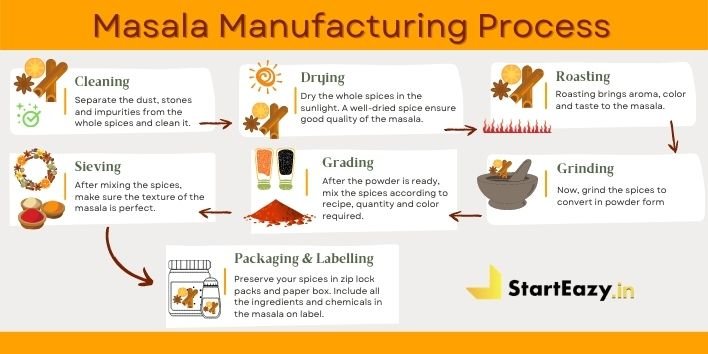
3.5 Production Process
- Procurement: Source organic spices from FPOs with NPOP certification.
- Cleaning and Sorting: Remove impurities using cleaning machines.
- Roasting: Roast spices to enhance flavor and shelf life.
- Grinding and Blending: Grind spices into powder and blend for specialty masalas.
- Packaging: Pack in biodegradable pouches with branding and FSSAI labels.
- Quality Control: Test for purity, flavor, and compliance with FSSAI standards.
3.6 Licenses and Permits
- MSME/Udyam Registration: ₹5,000.
- GST Registration: ₹5,000.
- FSSAI License (State): ₹5,377.
- Organic Certification (NPOP): ₹25,000.
- Pollution Control Board Clearance: ₹10,000.
- Total License Cost: ₹50,377.
4. Financial Plan
4.1 Initial Investment
| Item | Cost (₹) |
|---|---|
| Machinery and Equipment | 3,55,000 |
| Licenses and Permits | 50,377 |
| Initial Raw Materials (1 month) | 70,000 |
| Rental Deposit (3 months) | 60,000 |
| Miscellaneous (Utilities, Setup) | 54,623 |
| Total Initial Investment | 4,90,000 |
4.2 Monthly Operating Costs
| Item | Cost (₹) |
|---|---|
| Raw Materials | 70,000 |
| Labor | 78,000 |
| Rent | 20,000 |
| Utilities (Electricity, Water) | 15,000 |
| Marketing and Distribution | 20,000 |
| Miscellaneous | 5,000 |
| Total Monthly Cost | 2,08,000 |
4.3 Revenue Projections
- Production Capacity: 1,000 kg/month (600 kg ground spices, 400 kg blended masalas).
- Selling Price (Average): ₹250/kg (ground spices: ₹200/kg, blended masalas: ₹300/kg).
- Monthly Revenue: 1,000 kg x ₹250 = ₹2,50,000.
- Annual Revenue: ₹2,50,000 x 12 = ₹30,00,000.
- Profit Margin: 25-30% (after operating costs).
- Monthly Profit: ₹2,50,000 – ₹2,08,000 = ₹42,000.
4.4 Breakeven Analysis
- Breakeven Sales Volume: ₹2,08,000 / ₹250 per kg = 832 kg/month.
- Breakeven Timeline: Achievable in 2-3 months by optimizing production and marketing.
4.5 Annual Sales Target
- Target: ₹36,00,000 (1,200 kg/month x ₹250 x 12 months).
- Strategy to Achieve:
- Scale production to 1,200 kg/month within 6 months.
- Secure contracts with 3-5 retailers and 1 export buyer via IndiaMART.
- List on Amazon and BigBasket for 25% of sales.
5. Marketing Strategy
5.1 Branding and Positioning
- Brand Identity: Position Pahadi Masala as an organic, authentic brand rooted in Uttarakhand’s culinary heritage, emphasizing health and sustainability.
- Packaging Ideas:
- Use biodegradable kraft pouches with resealable zippers.
- Unit sizes: 100g, 250g, and 500g for retail; 1kg for bulk buyers.
- Label design: Earthy green and brown tones with Himalayan imagery, organic certification logo, and nutritional details.
- USP: Organic, locally sourced spices with authentic Pahadi flavors.
5.2 Marketing Channels
- Local Distribution: Partner with 5-7 retailers in Rudrapur, Dehradun, and Haridwar.
- Online Sales: List on Amazon, BigBasket, and a branded website (₹30,000 setup cost).
- Social Media Marketing: Use Instagram and WhatsApp for targeted ads and farmer stories (₹15,000/month budget).
- Community Engagement: Participate in local food festivals and organic fairs.
- Export Opportunities: Register on IndiaMART and APEDA for Middle East and European markets.
5.3 Sales Strategy
- Offer 10-15% introductory discounts to retailers and HoReCa clients.
- Introduce subscription models for urban customers via e-commerce.
- Collaborate with restaurants for bulk masala supply.
6. Sustainability and Scale-Up Potential
- Sustainability:
- Use biodegradable packaging to reduce environmental impact.
- Partner with FPOs to support local farmers and ensure fair trade.
- Adopt energy-efficient machinery to lower electricity costs.
- Scale-Up Potential:
- Year 1: Achieve breakeven and establish a local market presence.
- Year 2: Increase production to 1,500 kg/month, expand to Delhi-NCR, and secure 1-2 export contracts.
- Year 3: Invest in additional grinding and mixing machines (₹2,00,000) to reach 2,000 kg/month and target ₹48,00,000 in annual sales.
6.1 Government Scheme Convergence
- PMFME Scheme: Avail up to ₹10 lakh subsidy, covering 35% of project costs.
- PMKSY: Access grants for food processing infrastructure.
- MUDRA Loan: Secure low-interest loans for equipment and working capital.
- Application Process: Register on MoFPI portal and submit a Detailed Project Report (DPR).
7. Risk Analysis
- Market Risk: Competition from established brands. Mitigation: Focus on niche organic and Pahadi-specific masalas.
- Operational Risk: Supply chain disruptions for spices. Mitigation: Maintain a 1-month inventory and source from multiple FPOs.
- Financial Risk: Initial losses due to low sales. Mitigation: Start with 1,000 kg/month production and scale gradually.
8. Conclusion
Pahadi Masala is a viable small-scale masala processing unit with an initial investment of ₹4,90,000, capitalizing on Uttarakhand’s organic spice production and growing demand for authentic, health-focused products. By leveraging government schemes, e-commerce, and export opportunities, the unit can achieve breakeven within 2-3 months and generate ₹36,00,000 in annual sales by year 1. With a focus on sustainability, organic certification, and strategic marketing, Pahadi Masala is poised to become a leading brand in the spice market, supporting rural entrepreneurship and farmer welfare in Uttarakhand.